Showing posts with label Tor. Show all posts

May 22, 2012

Yeti Review: Bitter Seeds - Ian Tregillis


In A Few Words: The best debut of 2010, Bitter Seeds delivers on it's promise of Nazi Supermen vs. British Wizards; representing the start of a dark but brillant new trilogy that is as aggressive in scope as it is captivating in delivery. (2 stars)

Pros:
  • Well-written characters that carry the novel through grim subject matter;
  • Thought-provoking speculation that raises Bitter Seeds above the standard WWII reimagining;
  • The strong integration between alternate history of the war and the events of the book makes the notion of warlocks and psychics feel real; 
  • The implied structure of Milkweed Triptych promises continued originality and innovation

Cons:
  • The conclusion feels a somewhat anticlimatic as the second book is set up;
  • As more of a warning than a con, the tone of the story gets almost too dark at times;
  • Not enough Gretel.

The Review: The saying goes, "War is hell." In few novels is this more true than in Ian Tregillis's debut novel. An alternate history tale set during the darkest days of World War II; Bitter Seeds pits Nazi supermen against British demons in a sprawling battle that leaves everyone involved with deep scars: some physical, some emotional, and most both. Through a quartet of characters intimately involved in this secret war inside a war, Tregillis focuses on these scars and the wounds that cause them in a strikingly dark but equally impressive debut that has earned two stars in my new rating system.

Rather than trying to cover an alternate war in its entirety, Tregillis makes a wise decision and chooses to examine four lives within the war rather than the war itself. From Bitter Seeds’ first pages, it's clear that these four souls are not destined to lead normal lives. On the German side, the orphaned siblings Klaus and Gretel are purchased by Herr Doktor von Westarp for his abhorrent experiments. They and other war orphans are destined to become the Gotterelektrongruppe, a special Nazi outfit of supermen capable of flight, telekinesis, invisibility, and even precognition among other abilities. Klaus himself learns the ability to “ghost”; to pass through walls, bodies, and bullets like they don’t exist. His sister, Gretel, possesses powers of prediction that render her cryptic and, more often than not, incomprehensible. Gretel is the least written about character of the four but still manages to steal scene after scene with her bizarrely captivating antics and disrespect for causality.

Across the channel in the British Isles, a young Raybould Marsh is taken in by a British Intelligence Officer. Little does Marsh know that a career in intelligence will lead him to become involved with forces beyond his imagination. Elsewhere in England, the uncorrupted mind of Will Beauclerk is exposed to eidolons for the first time by his sorcerer grandfather. These entities reside outside the realm of human existence but are willing to interfere, at least for a price. Fast forward fifteen years or so and the world is on the verge of war. Raybould learns of the Nazi supermen during a routine espionage mission to Spain and he is soon tasked with stopping them. As such he reaches out to his college friend, Will, who possess a peculiar set of skills that just may level the playing field. From this brief description, it should be easy to see why the book is advertised as “Mad English warlocks battling twisted Nazi psychics.”

Bitter Seeds delivers on this promise in droves with several outstanding action sequences that just beg for big screen treatment. But underneath the exciting attempts to catch a man that can walk through walls and the orchestrated chaos of an ambush ruined by precognition, Tregillis conceals a wealth of character that helps the story transcend what could have been pure pulp. Now the premise and the execution are strong enough that Bitter Seeds would have been highly enjoyable pulp, but this unexpected depth takes Bitter Seeds from good to great.

Rather than depicting the white vs. black, good vs. evil reimagining of World War II that is all too common where Nazis are involved; Tregillis paints his cast in shades of gray. By focusing on the morality of the characters on both sides of the war and the motivations that can drive normal humans to commit atrocities, the book becomes incredibly gripping, albeit it in an almost perverse way. Another quote applicable to the first volume of the Milkweed Triptych has to be "all is fair in love and war."As the war escalates and the British become more and more desperate to halt the inevitable German invasion, the demonic eidolons demand more and more blood in exchange for their unnatural assistance.

The best science fiction is that which takes relatable ideas and uses speculation to stretch them to idealistic proportions. The idea that is explored here is that of the “Necessary Evil” (also the title of the third book of the Milkweed Triptych); one that frequently occurs in war when considering sacrificing a few for the needs of the many. But under what circumstances does the price become too high to pay? A death? A dozen? What if it's children? It is this grim question that plays heavily on both sides of the trenches and Tregillis sets the seeming unstoppable power of the German supermen against the crimson demands of the eidolons in order to raise the stakes until there is no right answer. Depressing? Yes. Thought-provoking? Without a doubt.

After a less than light hearted first third, this exploration forces the book to become darker and darker the book quickly gets even darker, almost to an excessive level. When a psychic Nazi appears to be the most well adjusted member of the cast, it’s difficult to generate empathy. But even at its darkest, Bitter Seeds never ceases to be compelling. There is a method to the sadness and Tregillis staggers the point at which characters hit rock bottom in a way so not to fully extinguish hope. If the first act sets up the characters as more than human, the second devolves Marsh, Beauclerk, and Klaus into something less than, and the third sees their attempt to pick up the pieces.

At first the conclusion feels somewhat underwhelming, in part due to the staggered nature of each of the character arcs. But as each of the characters concludes their final scene, we get a glimpse of the brilliant structure of the Milkweed Triptych, something that seems blatantly obvious in hindsight. In the last few pages, Tregillis teases the content of June's The Coldest War enough to make it instantly one of my most anticipated books of the year: a suitable accomplishment in its own right. In Bitter Seeds, Tregillis takes a played out setting and made it fresh again, crafting a darkly gripping tale that examines the morality of war through the lens of four superhuman characters who become anything but.

Mar 15, 2012

Covering Covers: The Rise of Ransom City - Felix Gilman


The only thing better than a clean, distinct cover is a series of clean, distinct covers. I can respect an art department that picks a direction and sticks with it. These two books will look mighty nice next to each other on the shelf.

The Rise of Ransom City continues Gilman's construction of a re-imagined world very different than our own. If typical steampunk stories are built from brass and copper, his half made world is made from platinum and gold.
In The Half-Made World, Felix Gilman took readers deep into a world on the cusp of forging an identity. The Line, a cult of Industry, and the Gun, a mission of Chaos, were engaged in a war for dominance, one that The Line was winning city by city, enslaving the populations it conquered. A doctor of psychology, Liv Alverhuysen, was caught in the middle, unknowingly guarding a secret that both sides would do anything to have.

Now Liv is lost on the edge of the world with Creedmor, an agent of the Gun, and the powerful Line will stop at nothing to find them.

But Harry Ransom, half con man, half mad inventor, is setting the edge of the world aglow. Town by town he is building up a bank roll and leaving hope in his wake because one of his inventions is actually working. But his genius is not going unnoticed, and when he crosses paths with the two most wanted outlaws in the “unmade world,” his stage becomes even larger and presents an opportunity more lucrative than any of his scams or inventions combined.
The Rise of Ransom City hits shelves November 27th, 2012.

Feb 8, 2012

Chronicle of GLORY!!!

Now I'm not usually one to boast but I received a special something in the mail today and I had to share...

Behold My Prize!!!

That's right, one of the first ARCs of The Coldest War - Volume Two of The Milkweed Triptych. And signed by Ian Tregillis no less...

All it took was a few obsessive compulsive days spent puzzling over the narrative challenge that was Chronicle of Sorrows, an ARG-esque enigma built into Tregillis's website. You can get the full scoop here. While all of the prizes have already been claimed (yetiwoot!) I would really recommend you give the game a try. It's fiendishly tricky AND it provides some pretty cool context to the first chapter of the excellent Bitter Seeds.

And if you haven't read Bitter Seeds yet, shame on you. Not only was it one of the best books of 2010, it's so good GRRM put off publishing A Dance With Dragons for another year just to avoid competing with it on Best of 2010 lists. The triptychular structure of the book is so awesome, Tor can't even calm down long enough to publish them on time. Stop what you are doing now, go read the book, them return here.

[::waits patiently::]

Welcome back. How good was that? Like me, you are now eagerly anticipating the follow up volume. Unlike me, you do not have a copy. But don't feel too bad. Although you probably won't be able to get a print copy of The Coldest War until it's release date in July, you can listen to the audiobook as soon as RIGHT NOW!!! over on audible.com. For reasons not entirely clear to me, the book has been edited for a long while, just not printed by Tor. As a result, the final edited copy was published via audiobook back in January. I can't do audiobooks, but if you can, have it at.

So to recap:

1) I've got a copy of The Coldest War. Bwa-hah-hah-ha.
2) Ian Tregillis has a really cool narrative game on his website. You should try it.
3) If you haven't read Bitter Seeds yet you should. It is awesome and available now..
4) The Coldest War will be available July 17th from Tor.
5) If you can't wait that long, The Coldest War is currently available via audiobook from audible.com.

I'll be in my bunk.

Oct 28, 2011

Covering Covers: Red Shirts - John Scalzi (with blurb)

Cover Designer: Peter Lutjen

Earlier this morning, Tor debuted the cover to John Scalzi's next project, REDSHIRTS. I received a call from a Tor employee shortly thereafter.

Tor: So what do you think about the cover?

Me: My opinion? I can't wait to read this book.

Tor: The cover makes you want to read the book?!?.

Me: Oh you wanted my opinion on the cover?It's alright I guess. It's kind of boring. But it doesn't really matter, I just want to read this book.

Tor: Yes, we understand that it's Scalzi. Everyone loves Scalzi. That's why we bought it. But we're asking you about the cover art. We don't just conduct probably fictional interviews with amateur bloggers to predict that a NYT Bestseller's book will do well. We employ an expensive sales team to do that.

Me: An expensive sales team? To predict if the next John Scalzi novel will be a bestseller? That seems a little overkill.

Tor: Well it's not that expensive. Besides we are publishing the next John Scalzi novel, that's going to sell like a gazillion copies. We can afford it.

Me: I'm not sure that's the best way to think about it. Wait, did you say "a gazillion copies"?

Tor: Yeah. I've got the sales report right here. [Sound of papers being moved around]

Me: I'll take your word for it. Listen, can I just talk to Irene Gallo?

Tor: Who's Irene Gallo?

Me: [silence]

Tor: Still there?

Me: Yes. But I'm starting to doubt this is a real call.

Tor: No, I'm really part of the Art Department. I can prove it!

Me: How?

Tor: I'll send you the alternate versions of the REDSHIRTS cover.

Me: You mean these?


Tor: Oh have you already seen those?

Me: Yeah, I love the 1st alternates. The 3rd isn't bad either. I think they're actually better than the final cover which, frankly, doesn't do a lot for me.

Tor: But I thought you said you liked the cover.

Me: No, I said I wanted to read the book. There's a difference.

Tor: Does that mean you're not going to buy it? I'll go get the sales team to rerun the numbers. We should have them by Thursday next week. We'll have to get Sanderson to write another book to pay for it, but I think he can have that to us by Wednesday if I catch him before he leaves.
Me: [facepalm] Let's move on. Is there anyway I could see the blurb?

Tor: [Clears throat]

Ensign Andrew Dahl has just been assigned to the Universal Union Capital Ship Intrepid, flagship of the Universal Union since the year 2456. It’s a prestige posting, and Andrew is thrilled all the more to be assigned to the ship’s Xenobiology laboratory. Life couldn’t be better...until Andrew begins to pick up on the fact that (1) every Away Mission involves some kind of lethal confrontation with alien forces, (2) the ship’s captain, its chief science officer, and the handsome Lieutenant Kerensky always survive these confrontations, and (3) at least one low-ranked crew member is, sadly, always killed. Not surprisingly, a great deal of energy below decks is expended on avoiding, at all costs, being assigned to an Away Mission. Then Andrew stumbles on information that completely transforms his and his colleagues’ understanding of what the starship Intrepid really is...and offers them a crazy, high-risk chance to save their own lives.
Did you get all that?
Me: Is there anyway you could just send it to me?

Tor: How? Like in the mail? I'm not allowed to buy stamps anymore.

Me: Wait what? Could you just e-mail it to me.

Tor: E-what?

[click]

Tor: Hello? Hello? ........... Hey Irene, I told you I could get a fanboy to willingly give up on an interview with me. I prefer 2-liters and thick cut, maple glazed, thanks.

Oct 18, 2011

Covering Covers: The Coldest War - Ian Tregillis (with blurb)


Cover Artist: Chris McGrath

So I've got a new policy around here. Keep everything in draft status until someone scoops me, and then get frustrated and post nothing. It's working like a charm so far.

Either way, in the off chance that you haven't seen it yet, here's the new cover art and catalog copy for the sequel to 2010's excellent Bitter Seeds which was so good that I don't really want to be friends with you if you haven't read it.

Now, I wasn't in love with the original cover art (below left) of Bitter Seeds but I admired the distinctive style. And who doesn't like swastikas? Update: Apparently everyone. Now we've got Chris McGrath stepping in once again to "fix" something that really wasn't broken. But don't get me wrong, the new cover (below right) isn't terrible, I just didn't think a change was warranted. I think had they stuck to the original style, they could have done something really subtle yet cool.


My meaningless opinions aside, here's the aforementioned copy:
Someone is killing Britain's warlocks.
Twenty-two years after the Second World War, a precarious balance of power maintains the peace between Great Britain and the USSR. For decades, Britain's warlocks have been all that stands between the British Empire and the Soviet Union—a vast domain stretchin from the Pacific Ocean to the shores of the English Channel. But each death is another blot blow [oops... corrected 16 Oct 11] to Britain's national security.
Meanwhile, a brother and sister escape from a top-secret research facility deep behind the Iron Curtain. Once subjects of a twisted Nazi experiment to imbue ordinary people with superhuman abilities, then prisoners of war in the immense Soviet research effort to reverse-engineer the Nazi technology, they head for England.
Because that's where retired spy Raybould Marsh lives. And Gretel, the mad seer, has plans for him.
As Marsh is once again drawn into the world of Milkweed, he discovers that Britain's darkest acts didn't end with the war. And while he strives to protect queen and country, he is forced to confront his own willingness to accept victory at any cost.
Seriously, if you haven't read Ian Tregillis's first book in the Milkweed Triptych, you're really missing out on the start of something incredible. You might think the WWII "British Demons vs. Nazi Supermen" genre doesn't have any stories left to tell, but if so, you're dumb. Fortunately, thanks to a-series-of-unfortunate-but-not-at-all-comical-but-equally-delay-inducing-events you'll have plenty of time to catch up while the rest of us eagerly await the next collision of sorcerers, spies, and seers amidst one form of global chaos or another.

The Coldest War will be published by Tor in July of 2012.

Hopefully.

Sep 2, 2011

John Scalzi's Next Novel Gets A Title

From Whatever -


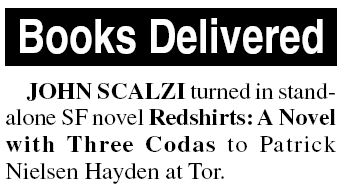
Redshirts: A Novel With 3 Codas. I know what you're thinking. However, Scalzi has already confirmed that it's not a Star Trek novel. Based on the title, I suspect it's intended to be quasi-humorous, if not to the same extent as Scalzi's excellent The Android's Dream.

Unfortunately, the title is all we've got to work with at the moment. Scalzi has read from the book at several conventions but Scalzi swore everyone to secrecy and surprisingly, no details have leaked out. Which is an incredible feat in and of itself.

Jul 24, 2011

Covering Covers: Shadows in Flight - Orson Scott Card

Cover Artist: John Harris

You can say what you want about the quality of OSC's most recent Enderverse work but there's no denying that John Harris's covers are still as good as it gets for Science Fiction. Whether it's Orson Scott Card, Ben Bova, John Scalzi, Jack McDevitt, or some random no-name - seeing Harris's iconic style on a cover will guarantee a second look from this reader. I've actually looked at purchasing some original Harris art. It may or may not be prohibitively expensive at the moment but I'm always accepting gifts and/or bribes. Hint, hint.

Now, I won't suggest that Shadows in Flight is a must read book. That honor is reserved for the brilliant first two Enderverse titles, Ender's Game and Speaker for the Dead, both of which won both the Hugo and the Nebula awards. But don't let that fool you, they're not just great SF novels, they're great novels. Period

But this many books into any series, it's up for each individual to decide if they want to keep reading. I personally enjoy both the Ender saga and its sister "Shadows" series but I'm also cognizant that the books aren't as good as they once were. We haven't reached Defcon Dune yet but it would be impossible to maintain the level of quality established in Card's first two books.  

Here's what Bean is up to in the latest "Shadow" novel.

At the end of Shadow of the Giant, Bean flees to the stars with three of his children—the three who share the engineered genes that gave him both, hyper-intelligence and a short, cruel physical life. The time dilation granted by the speed of their travel gives Earth’s scientists generations to seek a cure, to no avail. In time, they are forgotten—a fading ansible signal speaking of events lost to Earth’s history. But the Delphikis are about to make a discovery that will let them save themselves, and perhaps all of humanity in days to come.

For there in space lies a derelict Formic colony ship. Aboard it, they will find both death and wonders— the life support that is failing on their own ship, room to grow, and labs in which to explore their own genetic anomaly and the mysterious disease that killed the ship’s colony.

Orson Scott Card's return to the Enderverse will hit shelves on January 17th, 2012. Will you be reading it?

Apr 17, 2011

Yeti Review: Fuzzy Nation - John Scalzi


In A Few Words: A compulsively readable collision of tightly plotted legal thriller and idea-centric science fiction, Fuzzy Nation evokes fond memories of a simpler era of storytelling.

Pros:
-Light-hearted adventure appropriate for all ages.
-Holloway shines in a revamped, more cohesive cast
-Story moves quickly and continues to surprise even if you've read Piper's original Little Fuzzy
-Full of Scalzi's trademark humor, Fuzzy Nation is eminently entertaining and impossible to put down for the last 2/3 of the book

Cons:
-Jack Holloway is the same character we've seen from Scalzi multiple times before
-Ending wraps up a little too cleanly
-Antagonists are borderline archetypal, albeit very fun to hate.

The Review: Ladies and gentleman of the jury, Fuzzy Nation is a strange amalgamation of a book. The facts are clear: 1) It's a science fiction novel written by notorious internet troublemaker John Scalzi. 2) It's a more complex re-imagining of H. Beam Piper's Little Fuzzy. 3) It was originally fan fiction, written for personal pleasure and without the intention of ever being published. 4) It's revenge fantasy, allowing the reader to revel in the pain of a corporation too concerned with the bottom line and too willing to look the other way. And 5) as cliché as it is to say, Fuzzy Nation is also compulsively readable; a reminder that SF doesn't have to be as sterile as the vacuum of space.

Like so many space age novels, the original Little Fuzzy is a novel of ideas. Character and prose take back seat to the thought experiment of the Fuzziess, a newly discovered species that seems sentient but not undeniably so. After all, how do you define sentience? Scalzi returns to this same question half a century later but he does so within a genre that has matured significantly in the mean while. The once novel ideas of space exploration and alien encounters are fifty years played out, and it's no longer enough to simply wonder "what if?"

To that end, Scalzi gives Piper's original account of adorable aliens a welcome reboot and in the process manages to modernize the tale without sacrificing the optimistic heart at its core. Jack Holloway's persona might have been passed for "gritty" back in the space age but he'd be squeaky clean amongst the anti-heroes of today's fiction. Holloway 2.0 remains a prospector digging for sunstones on ZaraCorp's newest colony but now touts a law degree, a checkered past and a less than healthy affinity for Schadenfreude Pie. The other supporting players aren't so lucky - even though the story follows the same general arc as the original, Scalzi more or less replaces the cast in its entirety. The end result is an ensemble that feels more cohesive than its largely two dimensional progenitor (not to mention considerably less sexist).

It's this cohesion which allows Scalzi to deliver his revamped plot at a breakneck pace, pulling new readers in quickly while establishing that Fuzzy Nation is much more than a page-by-page remake of the original. The book starts with a bang - literally - and it's not much longer until Holloway discovers the titular Fuzzies, Scalzi's versions of which feature a little less prominently than Piper's critters. If Little Fuzzy depicts Holloway's relationship with the Fuzzies as impaired by ZaraCorp, Fuzzy Nation depicts Holloway's relationship with ZaraCorp as complicated by the Fuzzies. The difference is minor but nontrivial as Scalzi refines Piper's idea-centric explorations into a superiorly plotted story.

Either way, Holloway and his new-found furry friends are soon inextricably tied to ZaraCorp's financial future and it's employees start to test those links anyway they can, without regard to those silly things called laws. As the story races toward it's epic courtroom conclusion, those tightly wound threads begin to snap in unexpected places, much to the delight of anyone tired of the gross corporate malfeasance which plagues the world today.

Pleasantly distracting as it may be to see a corporation get what's coming to it, fans of Scalzi's popular blog will have no trouble recognizing his particular brand of biting rhetoric (and a penchant for pet anthropomorphism) in the ever-sarcastic (and dog owning) Holloway. The delicate balance of intelligent commentary and unrelenting snark has always been Scalzi's trademark and it's clear he knows what his audience has come to expect. Part of me worries that he isn't stretching himself enough narratively and as such risks overexposure of his primary voice. I'd hate to see him become the literary equivalent of a one hit wonder, stuck playing the same tune when he wants to diversify his sound. Fortunately, the other part of me isn't paying attention, he's two nostrils deep in the book and isn't coming up for air any time soon.

Ultimately, it's this hard to pinpoint "unputdownability" which really defines Fuzzy Nation. Like Little Fuzzy and so many of its space-age counterparts, the focus is less on the science itself, and more on the ideas and questions that science might one day allow us to explore. No advance theoretical physics degrees or quantum mechanics textbooks required. But that's not to say he ignores his physics; Scalzi clearly understands that the heavier something is, the more energy it takes to move it at a given speed. In support of this hypothesis, the prose is kept light and lean, allowing the reader to rocket through the book in just a few sittings.

After all, the key to a successful reboot isn't originality, it's execution - whether or not the changes you make result in a story worth reading, regardless if you've read the original. In Fuzzy Nation, Scalzi executes flawlessly, proving that Piper's core concept is just as relevant today as it was fifty years ago with a pitch perfect summer sci-fi novel that both embraces and enhances the source material. While there's still the lingering question of whether or not John Scalzi needs to write something outside his comfort zone, as long as his books are this entertaining, it's going to be difficult to prove that case in court.

Dec 1, 2010

Brandon Sanderson Is Ridiculous (And Publishing Two More Novels)

So we all know that Brandon Sanderson is ridiculous. Not only is he finishing doorstopper-class fantasy series The Wheel of Time, he's also penning another 10-book series with The Stormlight Archives. For reference, Book #1, Way of Kings (my review), checked in at 1004 pages. Combine those two series with his YA work (Alcatraz Versus the Evil Librarians) and he's pushing a million words of published work a year. Sound like a lot right?

So I was not exactly expecting the press release announcing that Brandon "Writes While He Sleeps" Sanderson has just sold another two novels to Tor. Here are the respective blurbs:


Mistborn: The Alloy of Law [4th Mistborn Book]
Sanderson’s first new project will be an original, standalone short novel set in the universe of his Mistborn trilogy (Mistborn, The Well of Ascension, and The Hero of Ages). Sanderson previously announced plans for a sequel trilogy set in the far future of that world, and the new novel, entitled Mistborn: The Alloy of Law, is set during a frontier era where “allomancy” meets gunplay. The Alloy of Law will be published in late 2011.
The Rithmatist [Standalone]

Sanderson’s second project, titled The Rithmatist, was first drafted in 2007 and perfected this year. Set in an alternate-history America where magic users (called “Rithmatists”) battle wild chalk creatures, The Rithmatist introduces Joel, a student at the Rithmatist academy with great interest in but no ability to use the magic. But when students start vanishing, it’s up to him to expose the sinister figure behind the disappearances. The Rithmatist will be published in 2012 after the publication of A Memory of Light.
So between 2011 and 2012, Sanderson will publish
  • Mistborn: The Alloy of Law [Mistborn #4]
  • A Memory of Light [Wheel of Time #14]
  • The Rithmatist
  • High Prince of War [The Stormlight Archives #2]
and that's not including the potential for more Alcatraz Versus the Evil Librarians books or other stuff. Keep in mind that all of Sanderson's work falls within the shared universe (referred to as the Hoidverse) where all magic is tied back to a currently undisclosed source/event. Talk about worldbuilding...

So if anyone is wondering why they have no writing talent or drive, it's because Sanderson took it. Look for and forward to plenty of Sanderson books in the years to come.

Nov 10, 2010

Yeti Review: Out of the Dark - David Weber

In A Few Words: Though it feels more like a popcorn movie than a fully developed novel, Weber's tale of alien insurgency provides a few hours of escapist fun.

Pros:
1) Weber writes action well, using military detail to underscore the human propensity for destruction;
2) The aliens vs humans setup is refreshingly pulpy in an "shades of grey" media culture.
3) Prose is smooth and fast-paced, well suited for the tone of the story

Cons:
1) Out of the Dark fails to live up to the potential of it's first act with some plot and pacing issues
2) The Shongari and humans are built from similar character stock, leading to character confusion;
3) The "twist" ending is telegraphed and poorly executed.


The Review: Out of the Dark is a strange title for David Weber's newest novel. While certain elements do emerge from unexpected places, their existence fails to be a revelation to anyone who has read the back cover (although I won't ruin them here). As a result, the kinetic account of humanity's resistance against an alien invasion rarely manages to surprise or innovate. However, like the your favorite popcorn movie, Out of the Dark suggests that sometimes you don't need to do anything extraordinary to still have a good time.

The curtain rises as an alien scouting expedition assesses the population of Earth circa 1066 AD. The verdict is not good for humanity - not only is Earth a planet ripe for colonization, it's exceptionally aggressive inhabitants are a danger to themselves and a potential danger to the other sentient races of the universe. But when the Shongari return with their invasion force almost a millennium later, they find that in addition to being brutally violent, humanity is also incredibly inventive. Compared to the other galactic civilizations, the denizens of Earth are progressing technologically at an unprecedented rate. But should the Shongari invade a civilization now capable of fighting back or do they let one of the most dangerous civilizations in the universe to continue to evolve unchecked? It's an interesting premise and one that is smartly setup, culminating in an attack that leaves a vast portion of humanity dead and the remainder wishing they were.

From there, the middle portion of Out of the Dark settles into a rhythm that may be best described as Independence Day as written by Tom Clancy. This is slightly disappointing as Weber's tight focus on disparate characters around the globe could have been to alien invasions what World War Z was to zombie hordes. But rather than presenting a comparably diverse set of characters, Weber uses the global reach of the American military complex to place soldiers (or equally militarized white males) into unimaginative situations. I was left wondering how the street gangs of Detroit were reacting to an invasion of their turf? Or what about a suburban soccer mom would do if her children were threatened by the wolf-like invaders? What of the men and woman of the Israeli Army? Or the citizens of Afghanistan who have known nothing but rebellion? What of the highly decentralized third world countries of Africa? The vast populations of India or China? There is so much unrealized storytelling potential. To be fair though, the tendency toward homogeneous male character stock is not a problem limited only to Weber - it is just particularly frustrating to see such a strong opportunity wasted.

While Weber's characters are mostly limited to militarized males, there is no debating that he is writing what he knows best. Weber goes into exquisite detail when describing weaponry, most likely with the intention of selling our military technology as a legitimate threat to the Shongari raiders. With an almost encyclopedic knowledge of armaments, Weber accomplishes this easily and the destructive ingenuity of the human race is a theme infused into in scene after explosive scene.

Though violent, the action conveys a pulpy innocence, creating a tone largely missing from an overly serious genre landscape. The heroes are actual heroes, the bad guys are undeniably alien, and while life on Earth definitely sucks, other homo sapiens are finally not to blame. Out of the Dark could have been a lot more but Weber isn’t trying to construct a bleak portrait of decades to come, he’s just to provide a little escapism in a world that is all to often repainted in shades of gray. Even if seems like a mismatch on the scale of Return of the Jedi sometimes it's fun to sit back and watch the Ewoks kill the Stormtroopers.

Like any good cinematic adventure, it’s important to sit back and enjoy it rather than dissecting it too much. A large portion of the book is spent developing the premise that humanity is a profoundly unpredictable culture and one capable of adaptation at an alarming rate. This is certainly true - the problem is that Weber fails to put a similar level of thought into the culture of the Shongari. They come across as cardboard creations and it's far too easy to forget who is who in the strangely Earth-like Shongari chain of command. As they fail to adapt to the humans' guerrilla methods time and time again, they quickly lose the threatening nature seized in the initial attack. This trend continues until the Shongari are all but caricatures of their original depiction. How does a species capable of travelling among the stars fall for the same tricks again and again?

It's these and other obvious questions that may ruin Weber's latest for many logic minded readers. Others may be turned off by the perverse (and thinly veiled) reflection of recent invasion/insurgencies. But despite my qualms, I couldn't help but enjoy the fast-paced novel. I will definitely be picking up the sequel, if only to see where the series goes after the frenetic conclusion. Not every book needs to be perfect to be worth reading, but a book's strengths should always outweigh its failings. Luckily for Weber, the pulpy "good vs. bad" atmosphere and high octane action contained in Out of the Dark manage to more than balance its inadequacies resulting in a popcorn novel that refuses to play in the shadows.

Nov 2, 2010

Covering Covers: The Book of Transformations - Mark Charan Newton


Cover Artist: Unknown

It's not that unusual to have a character make or break a book. Somewhat more atypical is having a character make or break a cover. But that's just what happened on the cover of Mark Charan Newton's upcoming The Book of Transformation. The absolutely stellar final cover is pictured above. But take a glance at what it used to look like:

To be fair it is a draft...

Aside from the Karate Kid, the cover appears more or less the same. This is striking as I would pick the final cover up of the shelf immediately (and consider buying it without reading a word...) but the original cover is so bad that the only way I would pick it up would be to turn it around so I didn't have to look at it anymore.

Here's the blurb for the third book in the excellent Legends of the Red Sun series.
A new and corrupt Emperor seeks to rebuild the ancient structures of Villjamur to give the people of the city hope in the face of great upheaval and an oppressing ice age. But when a stranger called Shalev arrives, empowering a militant underground movement, crime and terror becomes rampant.
The Inquisition is always one step behind, and military resources are spread thinly across the Empire. So Emperor Urtica calls upon cultists to help construct a group to eliminate those involved with the uprising, and calm the populace – the Villjamur Knights. But there’s more to Knights than just phenomenal skills and abilities – each have a secret that, if exposed, could destroy everything they represent.

Investigator Fulcrom of the Villjamur Inquisition is given the unenviable task of managing the Knights, but his own skills are tested when a mysterious priest, who has travelled from beyond the fringes of the Empire, seeks his help. The priest’s existence threatens the church, and his quest promises to unravel the fabric of the world. And in a distant corner of the Empire, the enigmatic cultist Dartun Súr steps back into this world, having witnessed horrors beyond his imagination. Broken, altered, he and the remnants of his order are heading back to Villjamur.

And all eyes turn to the Sanctuary City, for Villjamur’s ancient legends are about to be shattered…
 What a difference a character can make...

Oct 26, 2010

Covering Covers - The Quantum Thief - Hannu Rajaniemi


Cover Artist: Kekai Kotkai

The US cover of Hannu Rajaniemi's highly touted debut has a remarkably different feel than it's UK counterpart [displayed below]. Nonetheless, I like them both, particularly the sharp lines of the lasers/light beams and the geometric style of the "wings." And the horizontal lines stagger throughtout are subtle but cohesive. There is an element of "hard science fiction as magic" in The Quantum Thief that I think this cover captures well. It's definitely not the typical spaceporn that is assigned to most SF. Ignoring the title, I could definitely buy this as new design work for the newest Final Fantasy Game. I don't know if that's a good thing or not but I think it's applicable.

The font treatment also reminds me of another SF cover but for the life of me I can't figure out which one. Any help?


UK edition

The Quantum Thief is out now in the UK from Gollancz and will be released by Tor in the US in May of 2011.
Jean le Flambeur is a post-human criminal, mind burglar, confidence artist and trickster. His origins are shrouded in mystery, but his exploits are known throughout the Heterarchy - from breaking into the vast Zeusbrains of the Inner System to steal their thoughts, to stealing rare Earth antiques from the aristocrats of the Moving Cities of Mars. Except that Jean made one mistake. Now he is condemned to play endless variations of a game-theoretic riddle in the vast virtual jail of the Axelrod Archons - the Dilemma Prison - against countless copies of himself. Jean's routine of death, defection and cooperation is upset by the arrival of Mieli and her spidership, Perhonen. She offers him a chance to win back his freedom and the powers of his old self - in exchange for finishing the one heist he never quite managed . . .The Quantum Thief is a dazzling hard SF novel set in the solar system of the far future - a heist novel peopled by bizarre post-humans but powered by very human motives of betrayal, revenge and jealousy. It is a stunning debut.

Aug 30, 2010

Yeti Review: The Way of Kings - Brandon Sanderson


In A Few Words: The Way of Kings delivers on the hype, introducing a new fantasy series that echoes Wheel of Time in scope and complexity and has the potential to surpass it in writing quality and readability.

Pros: You will not get a better bang for your buck than the 1,000 pages of The Way of Kings; Highly readable fast-paced prose atypical in a fantasy doorstop; Sanderson takes standard tropes and make them his own, creating a cast of characters both recognizable and original; Subtle clues that will inspire discussion and rereading 

Cons: Very much an introductory volume, leaving a lot of questions unasked or unanswered; Kaladin flashbacks end up being somewhat prolonged and anticlimactic; Book 2 not due until 2012 at the earliest.

The Review: The most anticipated fantasy tome of 2010 is undoubtedly Brandon Sanderson’s Towers of Midnight. The best epic fantasy title of 2010 is also penned by Sanderson but that book does not belong to the classic saga started by the late Robert Jordan nearly two decades ago. Instead, that honor belongs to The Way of Kings, the first volume of The Stormlight Archives, in which Sanderson introduces us to Roshar, a world ravaged by torrential rain and torn apart by war, and the small cast of characters destined to stand against its storms.

At a high level the cast is generic - Dallinar, the noble noble playing a game of thrones – Adolin, the questioning son, loyal but unsure – Kaladin, the Gladiator-esque once-hero-now-slave trying to regain the honor and respect he once held – Shallan, a con-woman who becomes enamored with the person she pretends to be – Szeth, the unstoppable assassin who wants nothing more than to stop killing – but Sanderson uses his intimate familiarity with the genre to great effect, creating characters that are recognizable to fans but also distinct and memorable.

The forty odd words given to the characters above cannot do justice to the hundreds and hundreds of pages of complexity Sanderson uses to make the cast his own. If Sanderson’s cast is lacking is anything it is the scene-stealing antagonist that fans can love to hate. The closest character Sanderson provides is Szeth, more of an anti-hero than antagonist, whose vertigo inducing assassinations are some of the most spectacular scenes in the book. Either way, Szeth is destined to gather a loyal following as one of the genre’s favorite fighters.

This deficiency is not a problem per se but it is indicative of a frustrating aspect of The Way of Kings - there is no clear overarching plot to measure progress against. As such, it is difficult to fully judge The Way of Kings without knowing more about the series as a whole. Sanderson’s latest is very much a series debut, spending a wealth of words developing the complex world of Roshar and the people who inhabit it but only hinting at the overall plot of the planned ten book series. Despite the massive page count of the book, the vast majority of the action focuses on these five characters, four of which are tightly focused on the politics of Alethkar and its war with the Parshendi nomads following their assassination of the Alethkari king (and Dalinar's brother).

This leaves the fifth and shortest of the “major” POVs to lay a bloody foundation to The Stormlight Archives along with a small number of one-off “interludes” that appear to be only tangentially connected to the major perspectives. Even when taken together, these few pages barely scratch the surface of the larger tapestry on which The Way of Kings is woven. Likewise, Sanderson only provides brief glimpses into Roshar’s magic system. Somehow combined the incredibly curious Spren, Stormlight and Shardplate, the teases suggest that Sanderson has yet another of his trademark systems in store even if he is not ready to fully divulge its secrets.

Even though The Way of Kings provides disappointingly few overt clues at the overall direction of the series as a whole, that disappointment itself speaks to the quality of the story Sanderson has begun to craft rather than a flaw in his creation. Even with the 1,000+ pages of action and intrigue he supplies, the world of Roshar still begs for further exploration. Some doorstop fantasy novels claim to be epic in scope but the only thing epic about them is the nature of the editing fail they represent. When you struggle to get through page after page of tedium the end is a welcome blessing not a curse. This is not the case here.

Sanderson belongs to the less-is-more faction of worldbuilders and it shows in the relentless pace of The Way of Kings. The book moves swiftly, jumping from perspective to perspective and constructing Roshar through active exploration rather than passive infodumping. The only slow threads in the book are some of those which detail Kaladin’s backstory before becoming a slave. They feel somewhat prolonged and when Sanderson finally reaches the pivotal moment of his life, the revelation borders on the anticlimactic. Considering the aforementioned page count, much of his backstory could have been compressed and the extra pages could be removed or, even better, repurposed to explore more of Sanderson’s brilliant new world.

The last act is particularly demonstrative of the success of this introductory volume. As the fates of Dalinar and Kaladin align on the Shattered Plains, the story begins to move at such a pace and scope that it’s impossible to put down. At the same time, it’s hard to want to finish too quickly, considering that it will be years before the second volume hits shelves. Even when I did reach the dreaded conclusion, I found myself returning to reread some of the more initially ambiguous sections. While I faulted the book earlier for lacking overt direction, upon revisiting the most cryptic sections there is a seemingly endless supply of subtle clues to discover and discuss. Sanderson accomplishes the incredible, making a dauntingly long book read quickly and leaving the reader still wanting more.

In the end, it’s impossible to deny Sanderson’s talent for storytelling. Sanderson’s prose is impressive, possessing an almost cinematic quality. While most of the thousand or so pages read effortlessly, there are several scenes which transcend good storytelling and become utterly entrancing. Whether it’s Lord Dalinar resplendent in his Shardplate (an incredible creation in its own right), Kaladin in the midst of battle, or Szeth’s capacity for gravity defying carnage, his words leap off the page and into your imagination. The storytelling is further enhanced by the beautiful illustrations dispersed throughout the book, depicting some of the more abstract portions of his storm-influenced world on the rare occasion when Sanderson’s descriptive prowess is insufficient.

Based on the introductory volume alone, it’s hard not to agree with the bold claim that The Stormlight Archives has the potential to be for the newest generation of fantasy readers what The Wheel of Time was to the last. The subtle hints at the larger scope of The Stormlight Archives are sure to attract a rabid fan base that could easily rival Jordan’s, especially with the carry over that Sanderson’s Wheel of Time books are sure to generate. But I don’t want to make any guarantees based on only ten percent of the overall story.

At this point, the best praise I can provide to The Stormlight Archives is that I devoured the thousand pages of complex worldbuilding and imaginative storytelling contained in The Way of Kings and at the end I was still hungry for a thousand more. The most disappointing aspect of Sanderson’s new series is undoubtedly the fact that the second volume will not be out until 2012 at the earliest. I’ll be waiting.

Aug 10, 2010

Covering Covers: Knife of Dreams eBook - Robert Jordan


Tor has been recovering the Robert Jordan's classic fantasy series The Wheel of Time in lead up to the final two books, due out at the end of this year and late 2011/early 2012, respectively. While I'm not the biggest fan of the original covers to Jordan's books, I do applaud Tor for sticking with the artist through the end.

This morning, Irene Gallo debuted the new artwork for Knife of Dreams over at Tor.com

Cover Artist: Michael Komarck

I hope that when the series is done, Tor republishes the series in physical format with these new covers, either in paperback or HC. I would have to assume this is the case because it's a shame for such great work to only see the light of day in electronic format. My kindle doesn't even support color.

Michael Kormarck's reenvisioning of Knife of Dreams is no exception to the trend established by the previous artists. Kormarch has previously done a lot of work depicting scenes and characters from GRRM's A Song of Ice and Fire, one of the only series capable of competing with Jordan's masterwork. Irene Gallo comments on a sense of frozen motion and permanent imbalance in the work over in the blogpost and I must say I agree. And that photorealism is quite amazing.

Jul 19, 2010

Covering Covers: Shades of Milk and Honey - Mary Robinette Kowal


Cover Artist: Terry Rohrbach of BaseArtCo

I'm reading Shades of Milk and Honey now. I find this cover very peculiar. It's by no means bad -- the homage to period paintings is beautiful and the font choice feels natural with the art. I just feel like the marketing is going in two different directions (assuming of course, that this book will be shelved with the science fiction and fantasy books and not with period pieces over in Regular Lit). That would mean that the people the cover is most likely going to appeal to will not see it and the people who are mostly likely going to see the cover, won't pick it up. And I'm afraid that this possible distinction could negatively impact the beginning of a hugely promising career. Hopefully, I'm just plain wrong (about the negative impact, not the hugely promising bit).

If you are of the science fictiod and fantasy mindset and would not pick up this book based on the cover, at least read the summary of the book:
I do think that the cover is indicitative of the story. As of the halfway mark, Shades of Milk and Honey is a very quiet, intimate novel, especially compared to what I am used to. Shades is focused tightly on the two young girls and their attempts to find a desireable husband. So many of the books I read threaten the end of something major (be it planet, universe, fantasy world, United States, human race, etc.) and this change of pace is very welcome. In her short fiction, Kowal's stood out for her exceptional dialogue and for crafting realistic human relationships in only a few pages. So far, her debut novel is more of the same.
Shades of Milk and Honey is exactly what we could expect from Jane Austen if she had been a fantasy writer: Pride and Prejudice meets Jonathan Strange & Mr. Norrell. It is an intimate portrait of a woman, Jane, and her quest for love in a world where the manipulation of glamour is considered an essential skill for a lady of quality.

Jane and her sister Melody vie for the attentions of eligible men, and while Jane’s skill with glamour is remarkable, it is her sister who is fair of face. When Jane realizes that one of Melody’s suitors is set on taking advantage of her sister for the sake of her dowry, she pushes her skills to the limit of what her body can withstand in order to set things right—and, in the process, accidentally wanders into a love story of her own.
Shades of Milk and Honey comes out from Tor on August 3rd. Look for a review in the next few weeks.

Jun 25, 2010

Hannu Rajaniemi to the US!


Making the rounds on Twitter this morning when I saw some good news for Worth Watching Author Hannu Rajaniemi (and every US fan of science fiction).


Hannu's much hyped debut novel, THE QUANTUM THIEF, will be coming to the US next May in a Hardcover edition from Tor.

Quoting from John Jarrold's livejournal:
Susan Howe, Rights Director at Orion, has sold US rights in three novels by Finnish science fiction novelist, resident in Scotland, Hannu Rajaniemi to Patrick Nielsen Hayden of Tor pre-emptively, in a significant deal.


World rights in Hannu’s debut novel, THE QUANTUM THIEF, plus two further books were acquired pre-emptively by Simon Spanton of Gollancz (who publish in September 2010) from agent John Jarrold for a high five-figure sum in pounds sterling, on the basis of one chapter, in 2008. Tor will publish in hardback in May 2011.


‘I’ve known Patrick for twenty-five years and his team at Tor will do a marvellous job – Hannu and I couldn’t be happier,’ said John Jarrold.
If you don't know anything about The Quantum Thief, here's what Charles Stross had to say on the subject.
However, it made the hair on the back of my neck stand up when I read it, and I think Hannu's going to revolutionize hard SF when he hits his stride. Hard to admit, but I think he's better at this stuff than I am. And "The Quantum Thief" is the best first SF novel I've read in many years.
And a plot summary.
Jean le Flambeur is a post-human criminal, mind burglar, confidence artist and trickster. His origins are shrouded in mystery, but his exploits are known throughout the Heterarchy - from breaking into the vast Zeusbrains of the Inner System to steal their thoughts, to stealing rare Earth antiques from the aristocrats of the Moving Cities of Mars. Except that Jean made one mistake. Now he is condemned to play endless variations of a game-theoretic riddle in the vast virtual jail of the Axelrod Archons - the Dilemma Prison - against countless copies of himself. Jean's routine of death, defection and cooperation is upset by the arrival of Mieli and her spidership, Perhonen. She offers him a chance to win back his freedom and the powers of his old self - in exchange for finishing the one heist he never quite managed . . . The Quantum Thief is a dazzling hard SF novel set in the solar system of the far future - a heist novel peopled by bizarre post-humans but powered by very human motives of betrayal, revenge and jealousy. It is a stunning debut.


Congratulations to Hannu!
The UK always seems to have a ton of quality science fiction that doesn't seem to get published accross the pond so I am glad to see that a least a few of the gems are making the trip.

Jun 22, 2010

Covering Covers: Out of the Dark - David Weber


Cover Artist: Unknown

David Weber is a name that anyone who frequents the SF&F section should be familiar with. Although mostly known for his bestselling Honor Harrington novels, Weber has written in almost every subgenre imaginiable. He also writes at an incredible rate, publishing at least 2 books a year. The problem is that with so many books and so many ongoing series, its hard to find a good jumping on point.

Look no further than Out of the Dark.

Weber's latest is due out this fall (Sept 28th to be exact) and while SF, it seems to have a decidedly different take on it than his other more miltary SF work. I'll let the summary speak for itself.

Earth is conquered. The Shongairi have arrived in force, and humanity’s cities lie in radioactive ruins. In mere minutes, over half the human race has died.


Now Master Sergeant Stephen Buchevsky, who thought he was being rotated home from his latest tour in Afghanistan, finds himself instead prowling the back country of the Balkans, dodging alien patrols and trying to organize the scattered survivors without getting killed.


His chances look bleak. The aliens have definitely underestimated human tenacity—but no amount of heroism can endlessly hold off overwhelming force.


Then, emerging from the mountains and forests of Eastern Europe, new allies present themselves to the ragtag human resistance. Predators, creatures of the night, human in form but inhumanly strong. Long Enemies of humanity…until now. Because now is the time to defend Earth.
That's right. Vampires. Aliens vs. Vampires to be exact. While that tagline sounds a bit cheesy, the concept has a lot of appeal, especially in the serious SF setting it's placed in. And I'm assuming that these aren't your little sister's vampires.

But what first caught my eye was that gorgeous cover. People familiar with Weber's work will also be familiar with the...ummm....let's say "unique" style of the Baen covers. Regardless of what you thought of those, it's hard to deny that this is an eye-catching cover. It's got a definite Hollywood blockbuster feel to it and I'm looking forward to reading it.

After all, what happens when you shoot a vampire with a ray gun?

Jun 2, 2010

2 Extra Books for June


While I was making the rounds, I realized that two books slipped through the filters when I was selecting my YetiStomper Picks for June.

The first slipped by because I already picked up a limited edition from Subterranean Press. Next Tuesday, Metatropolis is being rereleased by Tor in a Hardcover format.
Five original tales set in a shared urban future—from some of the hottest young writers in modern SF

A strange man comes to an even stranger encampment...a bouncer becomes the linchpin of an unexpected urban movement...a courier on the run has to decide who to trust in a dangerous city...a slacker in a "zero-footprint" town gets a most unusual new job...and a weapons investigator uses his skills to discover a metropolis hidden right in front of his eyes.


Welcome to the future of cities. Welcome to Metatropolis.

More than an anthology, Metatropolis is the brainchild of five of science fiction's hottest writers—Elizabeth Bear, Tobias Buckell, Jay Lake, Karl Schroeder, and project editor John Scalzi—-who combined their talents to build a new urban future, and then wrote their own stories in this collectively-constructed world. The results are individual glimpses of a shared vision, and a reading experience unlike any you've had before.
You can find more of my own thoughts in this Covering Covers post I did a few weeks back.

AND if you are reading this post before June 7th or so, each of the 5 authors are hosting a different contest with the same prize: a free copy of Metatropolis. John Scalzi is looking for oil-free haikus. Elizabeth Bear is looking for photoshopped,captioned screenshots from the imaginary film version of Metatropolis. Jay Lake is holding a photography contest looking for images of what your personal Metatropolis looks like. In what may be a ploy for cheap/easy research, Tobias Buckell is looking for links to interesting articles on the topic of futuristic urban revitalization. Finally, Karl Schroeder is also looking for examples of crazy urban planning but is willing to accept anecdotal evidence on your honor.


The 2nd book that somehow missed my list is Mark Charan Newton's Nights of Villjamur. Sneaking into the very end of June from Del Rey, Nights of Villjamur is a very, very, very, very, very well reviewed fantasy novel. It's been out for a year or two over in the UK and the only thing that was keeping me from importing my reading experience was the announcement that the US release was only a matter of time. While I am guilty of obtaining more than a couple of books from across the pond, if the US release date is on the calendar I will generally hold off for the sake of the authors US sales figures. I'm sure those authors appreciate it. Nights of Villjamur is Fantasy with a touch of New Weird in an urban environment.
Following in the footsteps of writers like China Miéville and Richard K. Morgan, Mark Charan Newton balances style and storytelling in this bold and brilliant debut. Nights of the Villjamur marks the beginning of a sweeping new fantasy epic.


Beneath a dying red sun sits the proud and ancient city of Villjamur, capital of a mighty empire that now sits powerless against an encroaching ice age. As throngs of refugees gather outside the city gates, a fierce debate rages within the walls about the fate of these desperate souls. Then tragedy strikes—and the Emperor’s elder daughter, Jamur Rika, is summoned to serve as queen. Joined by her younger sister, Jamur Eir, the queen comes to sympathize with the hardships of the common people, thanks in part to her dashing teacher Randur Estevu, a man who is not what he seems.

Meanwhile, the grisly murder of a councillor draws the attention of Inspector Rumex Jeryd. Jeryd is a rumel, a species of nonhuman that can live for hundreds of years and shares the city with humans, birdlike garuda, and the eerie banshees whose forlorn cries herald death. Jeryd’s investigation will lead him into a web of corruption—and to an obscene conspiracy that threatens the lives of Rika and Eir, and the future of Villjamur itself.


But in the far north, where the drawn-out winter has already begun, an even greater threat appears, against which all the empire’s military and magical power may well prove useless—a threat from another world.
Additionally, if you aren't reading Mark's blog you are doing yourself a disservice. Mark has all kinds of interesting discussions and is very engaged with his readers and the blogosphere as a whole.

Anyway, my apologies for missing those two books. Be sure to check them out as well as all of the picks for June.

May 20, 2010

Covering Covers: Metatropolis [Tor Edition]


A while back at the always entertaining Whatever, SF author John Scalzi debuted the cover of the Tor edition of the collaborative world anthology that he edited and co-wrote along with Jay Lake, Tobias Buckell, Elizabeth Bear, and Karl Schroeder.

Cover Artist: Peter Lutjen

Entitled Metatropolis, this book visits 5 very different cities set in the same bleak tomorrow. Most would consider these settings dystopian, although a more realistic dystopia than your typical apocalypse. These novellas are futuristic visions of a world concretely grounded in the present. Metatropolis was originally published as an audiobook and later as a limited print special edition by the always spectacular Subterranean Press. For those readers who aren't clued in to the fantastic but expensive Subterranean Press, Tor is rereleasing Metratropolis in a mass hardcover edition next month (June 8th).

Metatropolis features an absolutely spectacular lineup of authors and if near to mid future SF is your thing, I'd definitely do some more investigation. The length of the stories perfect for familiarizing yourself with the authors' writing without investing in an entire novel (even though you couldn't go wrong with any of the featured writers).

I also really like this cover. It's got a great graphic vibe that hints at the larger world hidden within. Between the title and the buildings there are a lot of different hues but they manage to work together rather than distract. It's hard to determine how well the cover appears to speak to the target audience, mostly because it's hard to determine who that audience is in the first place. I would assume that it's the same crowd that enjoyed Bacigalupi's The Windup Girl and other ecological tinged stories. There aren't really enough sample books to notice a trend although I can see some parallels between the dilapidated buildings that grace both covers.

If you are looking for new authors, try Metatropolis. I guarantee you will find at least one you'll love, if not all five.
Related Posts Plugin for WordPress, Blogger...