Showing posts with label Night Shade Books. Show all posts

Mar 8, 2012

Covering Covers: The Croning - Laird Barron

No caffeine and 15 straight 15 hour days at work make YetiStomper something something...

What's that? Go crazy? Don't mind if I do. And speaking of misplaced sanity, Laird Barron's debut finally has a cover, and a excellent one at that.


Strange things exist on the periphery of our existence, haunting us from the darkness looming beyond our firelight. Black magic, weird cults and worse things loom in the shadows. The Children of Old Leech have been with us from time immemorial. And they love us. Donald Miller, geologist and academic, has walked along the edge of a chasm for most of his nearly eighty years, leading a charmed life between endearing absent-mindedness and sanity-shattering realization. Now, all things must converge. Donald will discover the dark secrets along the edges, unearthing savage truths about his wife Michelle, their adult twins, and all he knows and trusts. For Donald is about to stumble on the secret...of The Croning. From Laird Barron, Shirley Jackson Award-winning author of The Imago Sequence and Occultation, comes The Croning, a debut novel of cosmic horror.

Sanity is overrated anyway. Bring on the Barron!

Jan 23, 2012

Covering Covers: The Straits of Galahesh - Bradley P. Beaulieu

Cover Artist: Todd Lockwood
Cover Design: Claudia Noble
I suppose its okay. But it's no The Winds of Khalakovo.


If I saw both books on the shelf I would be drawn to Winds 10 times out of 10. It's unique, atmospheric, and clean. And the airship is awesome. The sequel is text heavy, blocky, and depicts a man about to lose his ability to have children after he slams his Galahesh into the title text box. Seriously though, he's both in front of and behind that thing. It's going to hurt.

But then again I'm not a marketing expert. If the new cover gets more people to buy into Brad Beaulieu's Cyrillic flavored fantasy series, great. A bad cover isn't going to stop me from reading it.

Here's the full layout.

Here's the back cover text blown up:
West of the Grand Duchy of Anuskaya lies the Empire of Yrstanla, the Motherland. The Empire has lived at peace with Anuskaya for generations, but with political turmoil brewing and the wasting disease still rampant, opportunists from the mainland have begun to set their sights on the Grand Duchy, seeking to expand their empire.

Five years have passed since Prince Nikandr, heir to the scepter of Khalakovo, was tasked with finding Nasim, the child prodigy behind a deadly summoning that led to a grand clash between the armies of man and elder elemental spirits. Today, that boy has grown into a young man driven to understand his past - and the darkness from which Nikandr awakened him. Nikandr's lover, Atiana, has become a Matra, casting her spirit forth to explore, influence, and protect the Grand Duchy. But when the Al-Aqim, long thought lost to the past, return to the islands and threaten to bring about indaraqiram - a change that means certain destruction for both the Landed and the Landless - bitter enemies must become allies and stand against their horrific plans.

Can the Grand Duchy be saved? The answer lies hidden within The Straits of Galahesh

From Bradley P. Beaulieu, author of the critically acclaimed debut novel The Winds of Khalakovo, comes Book Two of The Lays of Anuskaya, The Straits of Galahesh.
The 2nd book of Beaulieu's Lays of Anuskaya series will be out April 17th, 2012 from Night Shade Books.

Jul 7, 2011

eBook eConomics: Free-Ninety-Nine


Not good, skiffy fans.

Well, not really. More like good for us, bad for our collective fiscal solvency. Apparently, publishers have finally figured out that if you give people like me (and probably you) the option to click a button and receive an eBook for the price of a Katy Perry song or two, the results tend to be somewhat predictable. Unlike two consecutive blog posts invoking She Who Kisses Girls and Likes It. Who saw that coming?

Let's take a look at three different publishers who have been pummeling my purse money satchel recently (and the slightly different striking methods they use to do so). Also, it's worth noting that I'm a Kindler, not a Nookie, so apologies in advance if the mentioned deals don't translate to your preferred device. Blame divergent formats and DRM. I always blame DRM ever since they canceled Firefly. Don't tell them I told you.


Orbit

First in my eBook eXplorations (tIred oF tHis yEt?), is Orbit, a publisher whose 2011 slate is so good it violates that statutes of four nations, seven states, a single Canadian province, and a handful of ancient city-states (apparently along with the laws of physics). And the best part? They seem to be willing to spread the love around by offering a different deal every month through their "Orbital Drop" Program, mostly in the form of discounted and bundled backlist books. It's one newsletter you won't regret signing up for.

But Orbit isn't just focusing on their back catalog. In addition to this month's deal [3 of Gail Carriger's eclectic Parasol Protectorate novels for 9.99], Orbit is willing to part with two of this year's biggest books for less than a penny a page. Ten bucks will get you over 1 kilopage of Daniel Abraham goodness with the double eBook edition of The Dragon's Path and Leviathan Wakes. Even better, people who bought the eBook edition back in March received Leviathan Wakes three months before the rest of us. An advance edition premium for eBooks could be interesting, although I don't see it working in the long run.

All things considered, Orbit's strategy seems to be centered around limited time offers on bundles with the intention on introducing you to a few new series with the hopes you'll stick around for later volumes. I don't know what the audience overlap is between The Dragon's Path (fantasy) and Leviathan Wakes (SF space opera) but you can be sure FREE will help blur the lines a little more. And while Orbit does have some below double dollar deals [Kevin J. Anderson's The Edge of the World for $1.99 (Kindle Only)], they don't seem too eager to get into a price war with their bundle deals still pricing out between  $3.33 and $5.00 a book.


Night Shade Books

Night Shade Books is also in on the fun, albeit in a slightly different way. A large portion of Night Shade's output is anthology based - either with themed anthologies from John Joseph Adams, "Best of" anthologies from Jonathan Strahan and Ellen Datlow, or their eclectic Eclipse series, also from Strahan. They've got a problem though; anthologies don't have the same backlist appeal their novelular (it's a word, trust me) counterparts command. While I don't have the numbers to back it up, I think it's safe to assume most anthologies don't demand multiple printings. Particularly "Best of" books which are going to cannibalize their own sales year after year.  

Enter the eBook.

Unlikely their corporeal counterparts, their is little to no cost in producing an eBook "print run" of an infinite number of copies. Each book might not sell a lot of copies during its twilight years but what it does sell is sure to be almost pure profit. When you combine the two (infinite supply and high profit margins) you've got a fantastic formula for lowering prices to generate demand. Which is exactly what NSB is doing.

The latest volume of Eclipse might cost you $7.99 but the first volume is a down right affordable $2.99. And like the cosmic crack dealer they are, you better believe they are hoping to hook you on that first taste. I'm not sure what the driver is for dropping the price point (end of the print run? 3 years old?) but we can all be glad it's there.

In addition to their anthology business, Night Shade also makes a point of using eBook promotions to expose some of their newer authors to the hungry masses [at least for some eBook readers]. Recently, Brad P. Beaulieu's The Winds of Khalakovo and Will McIntosh's Soft Apocalypse were given away for free for Nook users as part of Barnes and Nobles' Free Friday Program. While one can argue that those downloads mean fewer sales, there's no denying that 77,229 extra copies of The Winds of Khalakovo in the wild will generate a lot of interest in a format that can't be easily lent to other readers. Not to mention the boost it should give to the second volume. 

Here is a sample of a few of Night Shade Books' more attractive deals. Sadly the free Nook giveaways have since ended.


Pyr

As Tim O'Reilly so aptly put it "the problem isn't piracy, it's obscurity", a motto which Pyr Books really took to heart. Like NSB, they know all about the power of selling something for free-ninety-nine. In fact they make a point of it, hoping to make up the difference when you return to finish one of their many multi-volume series (at full price). It's a great strategy and one more publishers should pursue, particularly those that typically traffic in long epics. Extended series have enough barriers to entry as it is, they don't need you counting your pennies before you jump into a ten book tale. Speaking of jumping in, you can try Kay Kenyon's Bright of the Sky or Joel Shepherd's Sasha right now for no risk.

If I published eBooks, once a series went to three books, I would give the first volume away for free (or close enough to not matter). No exceptions. And then watch my backlist sales climb as the new readership returns to the characters they've become invested in. Assume you've got 5 books in a series for $5 a pop - would you rather sell 0 books for $0 or 5 for $20?

Here's some of the goodness Pyr's got going for it at the moment.

Bright of the Sky: The Entire and the Rose, Book 1 - Kay Kenyon - FREE
Sasha: A Trial of Blood and Steel, Book 1 - Joel Shepherd - FREE
Empire in Black and Gold: Shadows of the Apt, Book 1 - Adrian Tchaikovsky - $1.99

[Side Note:  Empire in Black and Gold costs $9.59 on the Nook! And Bright of the Sky isn't available. Are you kidding me?]


Now at this point, I'm sure you're thinking that I've finally lost it - that I'm nothing more than a glorified publicity machine for "Big Book." Don't worry, I haven't sold out, I'm just completely selfish. Every book that I can help sell is another step toward convincing publishers that $1.99 is a price point that works. Which is good for me all of us. And by "all of us," I mean readers.

Authors, publishers, and distributors? Not so much.

So get to it, my expendable minions much appreciated readers. Are there any other publishers up to sales shenanigans? And what's this I hear about 99p eBooks across the pond?

Jun 1, 2011

Covering Covers: Southern Gods - John Hornor Jacobs


Yeah, I didn't get YetiStomper Picks for June done today. Blame beach volleyball, dinner with friends, and Portal 2.

Instead, here are two versions of John Hornor Jacobs' upcoming horror novel, Southern Gods. One was made by Jacobs himself, the other by Night Shade Books' marketing department.

But which one is which? And which do you prefer?


I personally like the one on the left. What do you think?


Recent World War II veteran Bull Ingram is working as muscle when a Memphis DJ hires him to find Ramblin' John Hastur. The mysterious blues man's dark, driving music - broadcast at ever-shifting frequencies by a phantom radio station - is said to make living men insane and dead men rise. Disturbed and enraged by the bootleg recording the DJ plays for him, Ingram follows Hastur's trail into the strange, uncivilized backwoods of Arkansas, where he hears rumors the musician has sold his soul to the Devil. But as Ingram closes in on Hastur and those who have crossed his path, he'll learn there are forces much more malevolent than the Devil and reckonings more painful than Hell... In a masterful debut of Lovecraftian horror and Southern gothic menace, John Hornor Jacobs reveals the fragility of free will, the dangerous power of sacrifice, and the insidious strength of blood.

Expect Southern Gods from Night Shade Books in August 2011.

Apr 15, 2011

Covering Contents: Eclipse Four - edited by Jonathan Strahan

Pretty in Pink?

Last year, Eclipse 4, (quite obviously the fourth entry in Strahan's excellently eclectic "Eclipse" series of anthologies) was pushed back from October to May of this year. I don't know if cause of the delay was ever fully explained but whatever the reason, I'm glad to know one of the few original anthology series will continue (at least through Eclipse 5).

As strange as it is to say, one of the strengths of the series is Strahan's refusal to pick a theme or at least his unwillingness to stick to one. Each book seems to be an almost random assortment of original work from strong genre writers, most of whom tend toward the literary end of the spectrum. My personal stance is that the Eclipse books are discovery anthologies. You won't love every story, not by a long shot - you might even hate a few. But there will also be a few that will surprise you, from writers you might never have heard of and which open your eyes to an new (or at least new to you) talent who will become one of your favorite authors.

As true as it may be, the seeming random end result doesn't keep Strahan from claiming to have had a strategy when he originally set out to build each anthology:
"What of Eclipse Four? In some ways it is the strangest and most eldritch volume yet. When I started work on it I intended it to be very much a sister volume to Eclipse Three, but like the wilful, living thing it is it insisted on being the book it would be, not an echo of its predecessor. During the nearly sixteen months I've been working on Eclipse Four writers have joined and left the book, have delievered and redelivered stories, and in some cases have moved from delivering one type of story to delivering another. In the end the fourteen stories [in Eclipse Four] range from tall tales to coming-of-age stories, move form the deep South to the outer reache sof our solar system, and approach everything from how we find love and happiness to how we cope with death and grief"
Here's the full list of those 14 stories:

  • Introduction - Jonathan Strahan
  • "Slow as a Bullet" - Andy Duncan
  • "Tidal Forces" - Caitlin R. Kiernan
  • "The Beancounter's Cat" - Damien Broderick
  • "Story Kit" - Kij Johnson
  • "The Man in Grey" - Michael Swanwick
  • "Old Habits" - Nalo Hopkinson
  • "The Vicar of Mars" - Gwyneth Jones
  • "Fields of Gold" - Rachel Swirsky
  • "Thought Experiment" - Eileen Gunn
  • "The Double of My Double Is Not My Double" - Jeffrey Ford
  • "Nine Oracles" - Emma Bull
  • "Dying Young" - Peter M. Ball
  • "The Panda Coin" - Jo Walton
  • "Tourists" - James Patrick Kelly

I can't say I'm especially excited for any particular story, except possibly  Swirsky's "Fields of Gold" or Ford's "The Double of My Double Is Not My Double". Not because I doubt the others are good stories, more so that I am largely unfamiliar with the work of the remainder of that list. Many I know by reputation (Swanwick / Bull), others are entirely new to me (Ball / Broderick). All I can say for sure is that Strahan is an editor I trust and Eclipse 4 looks to be another melting pot of imagination, adventure, and discovery.
Eclipse 4 will black out the sun on May 17th from Night Shade Books.

Dec 2, 2010

Table of Contents: The Best Science Fiction and Fantasy of the Year: Volume 5


Over on his blog, Jonathan Strahan has the scoop on Night Shade Books' fifth volume of "The Best Science Fiction and Fantasy of the Year" including the cover (above) and the full table of contents (below). As the anthology editor, he's probably a reliable source. Without sugarcoating it:
  • Introduction, Jonathan Strahan
  • “Elegy for a Young Elk" -  Hannu Rajaniemi
  • “The Truth is a Cave in the Black Mountains” -  Neil Gaiman
  • “Seven Sexy Cowboy Robots” -  Sandra McDonald
  • “The Spy Who Never Grew Up” -  Sarah Rees Brennan
  • “The Aarne-Thompson Classification Revue” -  Holly Black
  • “Under the Moons of Venus” -  Damien Broderick
  • “The Fool Jobs” -  Joe Abercrombie
  • “Alone” -  Robert Reed
  • “Names for Water” -  Kij Johnson
  • “Fair Ladies” -  Theodora Goss
  • “Plus or Minus” -  James P. Kelly
  • “The Man With the Knives” -  Ellen Kushner
  • “The Jammie Dodgers and the Adventure of the Leicester Square Screening” -  Cory Doctorow
  • “The Maiden Flight of McAuley’s Bellerophon” -  Elizabeth Hand
  • “The Miracle Aquilina” -  Margo Lanagan
  • “The Taste of Night” -  Pat Cadigan
  • “The Exterminator’s Want-Ad” -  Bruce Sterling
  • “Map of Seventeen” -  Christopher Barzak
  • “The Naturalist” -  Maureen McHugh
  • “Sins of the Father” -  Sara Genge
  • “The Sultan of the Clouds” -  Geoffrey A. Landis
  • “Iteration” -  John Kessel
  • “The Care and Feeding of Your Baby Killer Unicorn” -  Diana Peterfreund
  • “The Night Train” -  Lavie Tidhar
  • “Still Life (A Sexagesimal Fairy Tale)” -  Ian Tregillis
  • “Amor Vincit Omnia” -  K.J. Parker
  • “The Things” -  Peter Watts
  • “The Zeppelin Conductors’ Society Annual Gentlemen’s Ball” -  Genevieve Valentine
  • “The Lady Who Plucked Red Flowers Beneath the Queen’s Window” -  Rachel Swirsky
Checking in at 29 stories, the anthology boasts a stellar (and diverse...don't ask) assortment of authors, most of whom I've sampled. I think I've read something by everyone but seven or so. I also see that several of the writers are ones I identified as Authors Worth Watching [Rachel Swirsky, Ian Tregillis, Lavie Tidhar, Christopher Barzak, Theodora Goss, Hannu Rajaniemi]. My congratulations to them and all the others in the collection.

I would argue that Strahan's "Best of the Year" anthology series is quickly establishing itself as the premiere SFF collection. I'm sure a lot of people feel that Dozois's anthology is still king because of the seniority factor (26 volumes and counting) but Strahan selects fewer stories from a larger pool (including both SF and Fantasy). I'd rather read 25 great stories than 20 great stories, 20 good stories, and 10 okay ones. I've got plenty to read, keep it to the must-reads as much as possible.

Not to mention I love the Strahan anthology covers. What can I say? I'm a sucker for generic spacescapes.

The Best Science Fiction & Fantasy of the Year Volume 5 will hit bookshelves March 15th, 2011.

And as a parting topic for discussion, what's your favorite title? I'm leaning toward Peterfreund's “The Care and Feeding of Your Baby Killer Unicorn” although Doctorow's“The Jammie Dodgers and the Adventure of the Leicester Square Screening” has a certain charm. Unfortunately, sexagesimal isn't as dirty as it sounds.

Jul 26, 2010

Yeti Review: Occultation - Laird Barron


In A Few Words: The Stephen King of the Pacific Northwest, Laird Barron channels his past to produce a second collection full of literary horror that is as unfathomable as it is unforgettable.

Pros: The thematic balance of the natural and the unnatural works to create an atmosphere perfect for horror; Barron's style is very visual, creating images that will stick in your mind long after you finish reading; Barron's prose is dense but poetic and rewards multiple readings;  

Cons: Writing is not for anyone looking for a light read; Lovecraftian horror can often be purposefully hard to digest at times, especially the conclusions; Character focus on realism sometimes creates unlikeable protagonists.  

The Review: Do not go out in the woods. Bad things will happen. Do not go out alone. Do not go out in groups. Again, bad things will happen. If there’s one thing to be gleaned from Occultation, Laird Barron’s second collection of horror shorts, it’s that the deep forest of the Pacific Northwest is one seriously disturbing place. Out of all of the strange events chronicled in Occultation, the unifying element is an unnatural world hidden just beyond our grasp. On the surface, Barron regionalizes his horror in a style reminiscent of Stephen King’s backwater Maine, imbuing the forest and offending towns with an understated malice more appropriate in a stealthy predator than a copse of trees. On a less literal level, he takes everyday occurrences and distorts them along the way, letting the hidden horrible world bordering our own infest and corrupt late night pillow talk and light-hearted reunions with friends.

As a quick aside, it’s important to note that Barron is an accomplished outdoorsman, having grown up in Alaska and even raced the Iditarod on several occasions. In an interview I conducted with Barron last year, he mentioned that “growing up in an environment hostile to humans is a formative experience, physically and psychologically. Profound cold, profound heat, exaggerated extremes of light and dark, and intense isolation, are elements of the person I've become and inform the subjects I choose to write about.” I was often reminded of this response while reading Occultation, as the isolation his characters experience resonates strongly, both physically in the environments they explore and emotionally as a result of the supernatural ordeals they encounter. The saying goes, “write what you know” and it’s clear that Barron knows the world his characters inhabit intimately, both in its beauty and its horror.

Another common thread in Barron’s work is a propensity for the enigmatic ending. It is easy to get frustrated with the obtuse conclusions common in short fiction, especially where incomprehensible horrors are involved and Barron is frequently guilty of providing less when more is desired. Expect to reread more than a few pages in Occultation. I’m reluctant to mark this as a strength or a weakness in his fiction as the complex language is clearly deliberate. Barron’s work is not for skimmers or escapists, rewarding multiple readings with subtle detail - details often missed while plowing forward after the driving tension that fills his fiction.

Although the eight stories that comprise Occultation do share Barron’s strong literary prose and penchant for a slow-lead up to an abrupt conclusion, I would caution reader that you should read the stories in order rather than skipping around. There is a distinct pattern to the stories alternating between the occult, Lovecraftian Horror, and less supernatural fare. This keeps the stories fresh and interesting, avoiding the subgenre burnout that sometimes occurs in single author collections. I made the mistake of jumping around at first and started to wonder if all the stories shared the same dark fantasy vibe before being hit with a string of more unique stories, most notably the excellent Strappado. To better illustrate the structure, take a look at each of the stories in order:

The Forest - A suitable opening to Barron's second collection, The Forest both introduces and encapsulates Occultation. Friends with dark pasts, hidden knowledge, maddening encounters, disturbing revelations, the duality of the natural and the un – The Forest is all of this and more, throwing open the doors to the indescribable horrors that lurk just outside our imagination. Although the occult revelation is a common occurrence in all of Barron’s stories, the language captured in The Forest as a cinematographer is introduced to a world he had only glimpsed before is some of his best. The Forest also appears to be linked to Mysterium Tremendum and The Broadsword, set against a shared backdrop that begs for further exploration.

Occultation - The titular story of the collection is a strange one. Two lovers cling to each other while the world outside their motel bed is anything but ordinary. Surreal stories typically put me off due to their lack of logic but I enjoyed Occultation to a surprising degree. This short short finishes on an unexpected note and Barron’s writing creates a sharp visual that really stuck with me, particularly when I awake to a dark room in the middle of the night. This is one of those stories where you don’t realize how much it affected you until hours after turning the final page.

The Lagerstatte – Utilizing a nonlinear structure to great effect, The Lagerstatte depicts a woman’s psychological break after the loss of her husband and son. The story alternates between the “present” and a series of recordings of her psychiatric visits which illuminate her actions in the main thread. The structure of the story coupled with Barron’s supernatural world had me questioning if she was really crazy or not. I mentioned earlier that Barron often uses the seclusion of the natural world as a mirror for the most disturbing of his occult encounters and the final revelations of The Lagerstatte are a perfect example of that trend.

Mysterium Tremendum - Mysterium Tremendum is another entry in a linked series of tales (along with The Forest and The Broadsword) hinting at some unimaginable horror lurking just beyond reality. Two couples plan a camping trip in the Pacific Northwest using a recently discovered almanac of the occult and (as typically happens) discover more than they anticipated. While the Lovecraftian Horror that Barron concocts is purposefully hard to wrap your head around, there is no denying that whatever macabre monstrosities he creates, they are downright chilling in all the right ways. Barron builds up the story slowly in a profoundly unsettling fashion, something that seems to happen in most of his work to great effect. Mysterium Tremendum continues the trend of making the natural world anything but, and as the male protagonists delve deeper and deeper into the forest they find little of the solace they set out to find. The only criticisms I can raise are the four main characters felt a little too similar and were easily confused and that certain portions of the story felt a little superfluous (although it might have added to gradual build-up of tension). But definitely one of my favorite stories in the collection, overall.

Catch Hell - Catch Hell, a tale which sees a couple travel to a remote hotel in the Pacific Northwest (again, never go there) with a rather occult legacy. As always, Barron uses the natural world to draw out the unnatural to great effect, allowing the husband’s occult explorations to contrast to his wife’s less geographical but equally sinister quest. As is often the case with horror, my largest complaint is a personal one. I find that stories that throw logic out the window hard to wrap my head around and Catch Hell has arguably the most confusing conclusion of the bunch. This is particularly troublesome when the protagonists aren’t particularly enjoyable. After multiple rereads, I was reasonably sure of what happened to the characters during the surreal ending but I was still at a lost as to why I should care. This may be a love it or hate it type story.

Strappado - This short story was originally published in an Edgar Allen Poe inspired anthology and it is one of my favorites in the collection. So many of Barron's stories concern supernatural horror, so when he makes the abrupt change back to a human but no less grotesque evil, it is both unexpected and jarring. Two jetsetters find themselves invited to an exclusive after-after party and discover that it’s not quite what they signed up for. To provide further detail would ruin the story. It’s easy to disregard supernatural horror as a figment of your imagination but the when the carnage has a more human origin; it’s significantly more pervasive and disturbing. This is only compounded by Strappado’s tone and length in contrast with the more supernatural nature of the rest of Occultation’s stories. As a result, Strappado is one of the stand out stories of the collection.

The Broadsword – Although I read The Broadsword before I delved into the Mysterium Tremendum, I would argue that The Broadsword is a better introduction to the world shared by the two stories. Pershing Dennard is a long time resident of The Broadsword, an old hotel turned apartment complex that may or may not have been built on top of something else entirely. Where Strappado takes the quick approach, the gradual build-up of The Broadsword is equally effective. With a sentiment similar to that of Hitchcock’s classic Rear Window, Dennard begins to suspect that some of the residents of his building may be up to no good. The way Barron slowly unravels Dennard stable Broadsword based reality is masterful and the grotesque implications of the climax have cemented the story in my mind for months if not years. I only wish that Barron hadn’t been so ambiguous about the atrocious act in question.

--30-- – Two scientist-types are conducting researching on land once occupied by a cult that would make the Manson Family look normal. What could go wrong? Despite an unexpectedly strong final scene reminiscent of that of Occultation (for the creep factor, not the content), I thought –30—was one of the weaker stories in the collection. It’s not a bad story per se but while it touches on most of the themes that repeat throughout Occultation (particularly the theme of isolation), it feels like more of the same rather than an innovative work.

Six, Six, Six – Another “sinister revelation” story in which one member of a couple confesses the horrors of their past, Six, Six, Six is both a simple horror story and a meditation on child abuse coupled with the love/hate nature of familial obligations. The story occurs in a very small, domestic setting atypical to the collection but it carries the same sense of looming malice within its walls. As with many of Barron’s stories, the ending of Six, Six, Six is left more than a little unclear but I didn’t mind as much because of the startling clarity of the final scene. I liked it, though I’m not sure why or how. I don’t think that Six, Six, Six worked as well to close the collection as The Forest did to open it, but the story itself definitely lingers with you after you have shut the cover.

Taken together, these stories form yet another excellent horror collection (after The Imago Sequence and Other Stories) that both excites and profoundly disturbs. Barron’s prose is intelligent and exhilarating, subtly increasing the tension at a gradual pace before plunging abruptly into conclusions that are as unfathomable as they are powerful. The Forest, Mysterium Tremendum, and The Broadsword form a standout trio of possibly linked stories and Strappado, arguably the most realistic of the stories, manages to be equally good and no less menacing. Occultation reinforces the promise introduced by The Imago Sequence and it’s clear that Barron’s future in the genre is as bright as his work is dark.

Apr 21, 2010

Covering Covers: Occultation and Other Stories - Laird Barron


Laird Barron's 2nd collection, Occultation, comes out this spring from Night Shade Books. Here's the cover.

Cover Artist: Matthew Jaffe
Cover Design: Claudia Noble

I'm somewhat of a horror novice but from what I've read Laird Barron qualifies as a genre up and comer. Whoever wrote Occultation's blurb agrees:

Laird Barron has emerged as one of the strongest voices in modern horror and dark fantasy fiction, building on the eldritch tradition pioneered by writers such as H. P. Lovecraft, Peter Straub, and Thomas Ligotti. His stories have garnered critical acclaim and been reprinted in numerous year's best anthologies and nominated for multiple awards, including the Crawford, International Horror Guild, Shirley Jackson, Theodore Sturgeon, and World Fantasy Awards. His debut collection, The Imago Sequence and Other Stories, was the inaugural winner of the Shirley Jackson Award.

He returns with his second collection, Occultation. Pitting ordinary men and women against a carnivorous, chaotic cosmos, Occultation's eight tales of terror (two never before published) include the Theodore Sturgeon and Shirley Jackson Award-nominated story "The Forest" and Shirley Jackson Award nominee "The Lagerstatte." Featuring an introduction by Michael Shea, Occultation brings more of the spine-chillingly sublime cosmic horror Laird Barron's fans have come to expect.
Contents:
  • Introduction by Michael Shea
  • The Forest
  • Occultation
  • The Lagerstatte
  • Mysterium Tremendum (original to this collection)
  • Catch Hell
  • Strappado
  • The Broadsword
  • --30-- (original to this collection) (edited by author)
I actually like the cover to Barron's first collection, The Imago Sequence and Other Stories, more, mostly because covers with naked people tend to produce strange looks on the CTA buses. Not as many as actual naked people but I've got a reputation to uphold. Besides the random nudity, the cover is decent enough although I'm not sure how well it targets the intended audience. On the other hand, I don't know who the audience is for horror themed short fiction collections and what that audience reacts to. Does that reader base even go into brick and mortar stores looking for new collections? Those questions aside I'm still very excited for this collection despite my reservations with the nudity of the cover.

Occultation is scheduled to hit shelves on May 15th, 2010.

Dec 18, 2009

Table of Contents: Year's Best Science Fiction and Fantasy, Volume 4


Over at Notes from Coode Street, Jonathan Strahan has announced the contents of Best Science Fiction and Fantasy of the Year, Volume 4 which hits shelves March 29th.

Introduction, Jonathan Strahan
1. It Takes Two, Nicola Griffith (Eclipse Three)
2. Three Twilight Tales, Jo Walton (Tor.com)
3. Secret Story [To Be Announced in March]
4. The Island, Peter Watts (The New Space Opera 2)
5. Ferryman, Margo Lanagan (Firebirds Soaring)
6. A Wild and Wicked Youth, Ellen Kushner (F&SF)
7. The Pelican Bar, Karen Joy Fowler (Eclipse Three)
8. Spar, Kij Johnson (Clarkesworld)
9. Going Deep, James Patrick Kelly (Asimov’s)
10. The Coldest Girl in Coldtown, Holly Black (The Eternal Kiss)
11. Zeppelin City, Michael Swanwick & Eileen Gunn (Tor.com)
12. Dragon’s Teeth, Alex Irvine (F&SF)
13. This Wind Blowing, and This Tide, Damien Broderick (Asimov’s)
14. By Moonlight, Peter S. Beagle (We Never Talk About My Brother)
15. Black Swan, Bruce Sterling (F&SF)
16. As Women Fight, Sara Genge (Asimov’s)
17. The Cinderella Game, Kelly Link (Troll’s Eye View)
18. Formidable Caress, Stephen Baxter (Analog)
19. Blocked, Geoff Ryman (F&SF)
20. Truth and Bone, Pat Cadigan (Poe)
21. Eros, Philia, Agape, Rachel Swirsky (Tor.com)
22. The Motorman’s Coat, John Kessel (F&SF)
23. Mongoose, Sarah Monette & Elizabeth Bear (Lovecraft Unbound)
24. Echoes of Aurora, Ellen Klages (What Remains)
25. Before My Last Breath, Robert Reed (Asimov’s)
26. Jo Boy, Diana Wynne Jones (The Dragon Book)
27. Utriusque Cosmi, Robert Charles Wilson (The New Space Opera 2)
28. A Delicate Architecture, Catherynne Valente (Troll’s Eye View)
29. The Cat That Walked a Thousand Miles, Kij Johnson (Tor.com)

I find it very interesting that Tor.com has 4 stories making the anthology. If I'm correct, they've been around for less than a year. Quite a start. I didn't realize that the fiction over there was so strong. I don't typically read a lot of fiction online because I prefer the book form to get away from the screen when possible. Out of the big three F&SF has 5 stories, Asimov's has 4, and Analog 1. That would put Tor.com on pace with any of the big 3 short fiction magazines.

Also, congratulations to Alex Irvine and Elizabeth Bear (Keeping An Eye On Authors and friends of the site) on writing stories that made it into the book.

Also, all 29 authors happen to be all women, what's up with that?

Made you look. Just Kidding!

Oct 26, 2009

YetiReview: The Windup Girl


21 Words or Less: Bacigalupi's debut novel delivers on the promise of his early work with a complex portrait of an environmentally influenced future Thailand.

Rating: 5/5 stars

The Good: Bleak but believable future setting that begs for further exploration; a diverse set of interesting characters that are human, sympathetic, and unique; Prose conveys complex technological and cultural details in an elegant manner that reads amazingly well.

The Bad: A fair bit of Thai words had me running to Google on a frequent basis; there aren't any more Bacigalupi novels to read offhand.

There's a reason Paolo Bacigalupi's name came up the most when discussing promising new authors. To understand why, you don't need to look any further than The Windup Girl, Bacigalupi's debut novel. Set in a future Thailand that struggles to survive in a world devastated by pandemic and crop failure, The Windup Girl depicts five characters who are poised to influence the country's future whether they realize it or not. As their actions weave together through the complex tapestry of the future setting, Bacigalupi creates a story that both excites and frightens.

The Windup Girl is part of the new wave of environmentally influenced science fiction that places one foot in the future and the other squarely in the past. Anticipating the end of cheap energy and global resource shortages, these novels are equally recognizeable and difficult to accept. In The Windup Girl, the advancements of genetic manipulation of viruses and seedstock, hyper-evolved animals built for performance, and even humans scientifically engineered for beauty and obediance are balanced out by the regressions resulting from the end of cheap energy. A return to animal labor, the expense of communication or computation, the financial power represented by dependable electricity, and even subtle touches like a scarcity of ice. One especially poignant scene shows a team of poor workers running up flight after flight of stairs only to serve as ballast weight for the rich man's elevator. All of these details taken together makes the world feel exceedingly real, moving into the future while retaining the links to the past.

My only complaint about Bacigalupi's constructed world is that I want to see more of it. I want to travel Europe's great cities to see what they've become, return to an America originally built upon bottomless wells of oil that have since run dry, and see if the pristine jungles of South America still survive. This setting begs for more stories, and I hope we get them particularly if they are as expertly crafted as The Windup Girl.

It's not only Bacigalupi's setting that impresses, it's his characters. He expertly maintains half a dozen points of view characters without resorting to anything that feels overly stereotypical on contrived. There is more (and better) characterization in The Windup Girl than some books twice as long with half the number of characters. Each character is fully realized with their own motivations, history and failings. I would warn you that if you are looking for black-and-white conflict, this isn't a book for you. These are realistic people, not comic-book characters. They aren't perfect but they are human (even the ones that aren't). I'm tempted to get into more specific details but I'd rather let you get into the characters yourself.

The one thing I think that would benefit the book would be the inclusion of an index for the many Thai words. A lot of them you could guess at but the early chapters were a little jarring as you tried to suss out the meaning of the Thai slang. I would draw comparisons to Ian McDonald's Brasyl in terms of cultural details. The Windup Girl is full of them, from big picture regional politics and religious conflicts to more subtle details like clothing choices and food items. Similar to the little touches that connect the present to the future, these cultural details link the words on the page to a real place.

In fact, I would say that Ian McDonald's Brasyl is the closest thing to The Windup Girl in the last few years. Except that this book is better. Where Brasyl and similar books focus on the cultural details or the delightful little world they've built, they often do so in a way that's a little bit too much infodump or not quite enough plot structure. Bacigalupi wraps all of these brilliant pieces into a cohesive package that reads effortlessly and with a literary style uncommon in genre fiction. It's got all of the complexity you would expect from genre fiction but without any of the heavy reading. It's hard to describe exactly what Bacigalupi does, or how exactly he does it (if I knew I'd be writing right now) but it works.

If it isn't clear to you by now (or the 3 week wait after I finished the book), I had a incredibly hard time writing this review. I simply can't exactly illustrated why The Windup Girl resonated the way it did with me. The simpliest way I can put it is that Paolo Bacigalupi has written a novel that delivers everything I look for in science fiction and more.

Go read this book.

Sep 30, 2009

YetiPreview: The Wind-Up Girl


After the dense and somewhat disappointing The Quiet War (review) and the light, fun The Lost Symbol (review), I'm plunging back into the Sci-Fi deep end with paolo Bacigalupi's debut novel The Wind-Up Girl.


I already gave my feedback on the cover in a Covering Covers post (quick summary: absolutely fantastic cover except for the top left and bottom right text) but I have to say I'm excited to finally get my hands on a Bacigalupi novel. His Pump Six and Other Stories simply blew me away. It was bleak, depressing, and I couldn't get enough. It wouldn't be a stretch to say that this is my most anticipated book of 2009 and I guarantee it's in the Top 5.

I'm a bit late in posting this as I'm already a hundred or so pages in but so far The Windup Girl has not disappointed. Bacigalupi paints a future landscape with such deft brushstrokes that you don't even notice as he gives you the tour of the place. It's world-building but it's top-notch and expertly subtle. I would go on further but I want to save some of my thoughts for the review.

My only complaint so far are the frequent use of Thai words. While they're probably accurate, I've only picked up only some of them so far and it bugs me not to know the exact context of the words. Much like Ian McDonald's Brasyl, The Windup Girl could definitely benefit from a glossary at the end of the book. And unlike Brasyl, I looked for a glossary first so I didn't struggle through the cultural elements for the majority of the book before finding it.

Expect a review up sooner rather than later because I am loving what I've read so far.

Jul 23, 2009

Congrats to Laird Barron


Just a quick note, Laird Barron (who happens to be one of the authors that I'm Keeping an Eye On has sold a collection and DEBUT NOVEL to Night Shade Books.

Throughout the interview process, I've noticed that many of these "future genre stars" are at that critical first novel point in their careers. Some have a few books out, some are still shopping them to publishers, and some are still making the transition from short story. This is a huge deal for any developing author so I'm sure Laird is ecstatic. Here's Laird's announcement:

I am proud to announce that my agent Brendan Deneen has sold my second collection and debut novel to Jeremy Lassen at Night Shade Books. These will appear in October 2010 and summer 2011 respectively.

The collection is titled OCCULTATION and is introduced by Michael Shea.

TOC

Introduction: Michael Shea
The Forest
Six, Six, Six
The Lagerstatte
Strappado
Occultation
Catch Hell
The Broadsword
--30--

"Six, Six, Six" and --30-- are orginals. Two of the stories are in the vein of Lovecraftian dark fantasy. The rest are occult and psychological horror pieces. In many ways the collection is a departure from THE IMAGO SEQUENCE. The book clocks in at about 90k, so it's leaner than the first one.

The novel is called THE CRONING. It's kind of like ON GOLDEN POND, if Henry and Jane Fonda were preoccupied with black magic, machetes, and cosmic horrors. This one is still underway with an estimated delivery date of July 2010.


Definitely sounds interesting. Lovecraftian is always fun and who doesn't enjoy a good occult story as long as it's not happening to you. The only downside is 2011! That's not tomorrow.

Head over to Laird's livejournal and congratulate him.

Jul 13, 2009

Covering Covers: The WindUp Girl


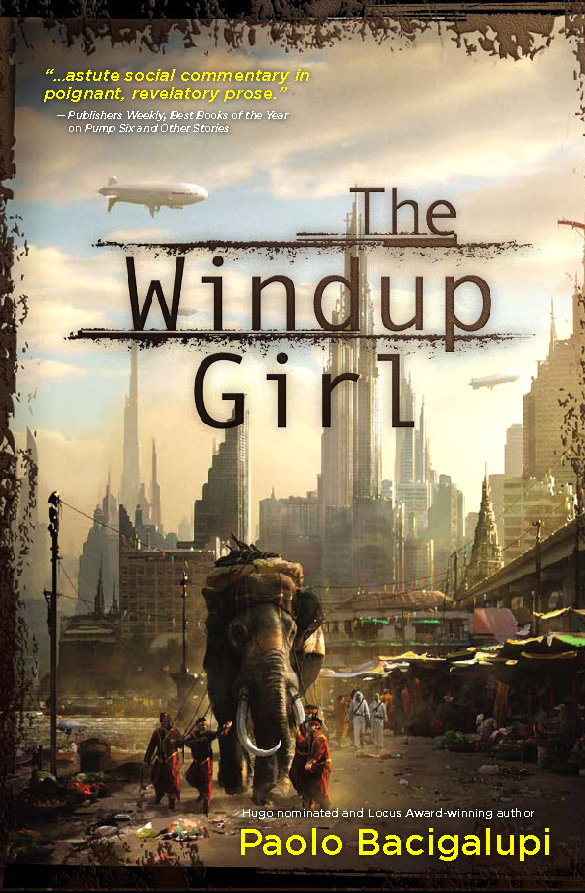
Over at his website, Paolo Bacigalupi is showing off the cover to his debut novel The Windup Girl. And what a cover! A little digging (i.e. a quick Google search) revealed the cover art was done by Raphael Lacoste (Link) who I don't know if I've ever heard of doing cover art before. But looking at that cover and some of the work on his website, I would like to see more covers from him.

The artwork is fantastic. I love the megodonts (genetically engineered elephants originally referenced in Bacigalupi's fantastic short story anthology Pump Six and Other Stories) and how "Mammoth" they look. The dualism of the trash littered slums versus the futurisitic high rises is a great visual and also ties into some of the themes that were prevelant in Bacigalupi's short stories "The Calorie Man" and "Yellow Card Man" both of which take place in the same future setting as The Windup Girl. Covers that actually echo the content of the book are few and far between in today's publishing landscape.

I also love the title font and it's placement. The two lines seperating the title really make it pop and emphasize some of the background artwork in interesting ways. I'm less entralled with the blurb and the author text but I have a sneaking suspicion that that might not be the final edit. The pixelation and simplicity scream Microsoft Paint.

The publisher's summary is also available on the publishers website (Night Shade Books)

Anderson Lake is a company man, AgriGen's Calorie Man in Thailand. Under cover as a factory manager, Anderson combs Bangkok's street markets in search of foodstuffs thought to be extinct, hoping to reap the bounty of history's lost calories. There, he encounters Emiko...

Emiko is the Windup Girl, a strange and beautiful creature. One of the New People, Emiko is not human; instead, she is an engineered being, creche-grown and programmed to satisfy the decadent whims of a Kyoto businessman, but now abandoned to the streets of Bangkok. Regarded as soulless beings by some, devils by others, New People are slaves, soldiers, and toys of the rich in a chilling near future in which calorie companies rule the world, the oil age has passed, and the side effects of bio-engineered plagues run rampant across the globe.

What Happens when calories become currency? What happens when bio-terrorism becomes a tool for corporate profits, when said bio-terrorism's genetic drift forces mankind to the cusp of post-human evolution? In The Windup Girl, award-winning author Paolo Bacigalupi returns to the world of "The Calorie Man" ( Theodore Sturgeon Memorial Award-winner, Hugo Award nominee, 2006) and "Yellow Card Man" (Hugo Award nominee, 2007) in order to address these poignant questions.
The Windup Girl will be available in September. This is a must buy for me for sure. I absolutely loved Pump Six and Other Stories particularly the all-too-real feel of this future world in which calories are cash. If you haven't done so, I would recommend reading Pump Six before The Windup Girl is released.
Related Posts Plugin for WordPress, Blogger...